It’s been stunning to watch Scientology’s drug rehab network, Narconon, plunge into crisis over the last year after several deaths at its facilities in Oklahoma and Georgia.
But a key part of that crisis has been the emergence of former Narconon employees who have come forward to detail the network’s deceptive practices. Last year, we published the first damning accusations by Narconon Arrowhead’s former president, Luke Catton, who has become a vocal source about Narconon’s methods (and he has a new book out).
And now, another formerly high-ranking Narconon employee has gone public with damning new allegations that are quickly having an effect. Because of Eric Tenorio’s allegations about the way Narconon has certified its employees as drug counselors, some of those certifications are being revoked as a new investigation is being launched, the Underground Bunker has learned.
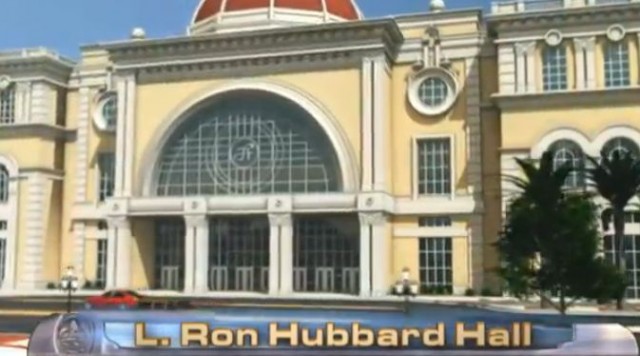
On Tuesday, we noted that Scientology not only has still not opened its “Super Power” Building — which it started building almost 15 years ago — but that it says its Clearwater, Florida “mecca” won’t be complete until it builds a major new auditorium — the L. Ron Hubbard Hall — on Super Power’s south side.
The Hall was always part of the plans dreamed up for the mecca in the 1990s, but we wondered if waiting for the Hall to be built will set back the opening of Super Power even further. We don’t know about that yet, but one of our tipsters did us a favor by visiting the site of the future Hall to snap some photos yesterday. After the jump, our tipster’s report on what the place looks like.
Yesterday, Oklahoma’s Senate voted 46-0 to approve a bill authored by Sen. Tom Ivester which will require drug rehab facilities to be licensed by the state mental health board.
Senate Bill 295 now goes to the House, and if it’s approved there, will go to Oklahoma Governor Mary Fallin for signing.
If the bill becomes law, it will take affect on November 1. And if that’s the case, Scientology’s flagship drug rehab facility, Narconon Arrowhead, could be in big trouble.
Earlier today, we talked to Senator Ivester about his bill and its chances of becoming law.
We want to thank Professor David Touretzky of Carnegie Mellon University, who sent us down this rabbit hole a few days ago.
He pointed us to a news item that has grabbed considerable attention in the academic world, although Gawker thinks it can’t be any more boring.
Here’s the thumbnail: An academic librarian at McMaster University in Ontario named David Askey is being sued for millions because in 2010, when he was still a tenured associate professor at Kansas State University, he wrote a blog post criticizing the quality of books put out by an academic publisher, Edwin Mellen Press.
Who cares, Gawker asks. Well, we think you might care after you hear more about Edwin Mellen Press, about the odd way Scientology is involved, and about a guy named Herbert Richardson.
A year ago, we made public hundreds of schematics showing plans for Scientology’s “Flag Mecca,” known colloquially as the “Super Power” building. The city-block-sized, 300,000-square-foot monstrosity across the street from the Fort Harrison Hotel in Clearwater, Florida first broke ground in 1998, and even after the church was forced to pay $413,500 in penalties to the City of Clearwater in 2011 because of delays in its construction, there’s still no indication when it will open.
One of our tipsters noticed that this video featuring the Super Power building was posted Saturday on the church’s official YouTube channel. Hidden near the end of the segment — about 50 seconds from the finish — there’s news of yet another major project to be built next door to the Super Power building, one that looks like it could take several more years and millions more in construction
All hail “L. Ron Hubbard Hall,” David Miscavige’s newest excuse to delay opening his major fundraising boondoggle!
Last week, we learned that Tom Cruise is playing hardball in his $50 million defamation lawsuit against Bauer Media, publishers of In Touch and Life & Style. Cruise sued after the magazines said he’d “abandoned” his daughter Suri following his split with Katie Holmes last summer. Cruise has indicated that he’ll use depositions and document discovery to portray Bauer as a publisher of porn and magazines that appeal to neo-Nazis.
But if Cruise goes forward, he’ll be subject to his own deposition by Bauer, and that gave us an idea. What sort of questions might the actor be asked, and how might he answer — if he were being completely truthful, that is? An actual deposition could take months to happen, but we’ve asked some people who know a lot about his involvement in Scientology to help us come up with this simulated interrogation. We only hope the real thing turns out to be half as fun!
On Sundays, we love to bring you all the best that Scientology has to offer. The fliers and mailers and announcements about its good works around the globe.
It’s become a highlight of the week here at the Bunker, and we hope you enjoy this week’s offerings, which are brought to us by our tipsters near and far.
This week, we ponder the theta environment at Saint Hill Manor, cogitate over the miracles of the Bridge to Total Freedom, and of course get a vital update from the Library Campaign.
Also, we get some inspiration from a motivational speaker who is in a league of his own. We think you’ll agree with us on that one.
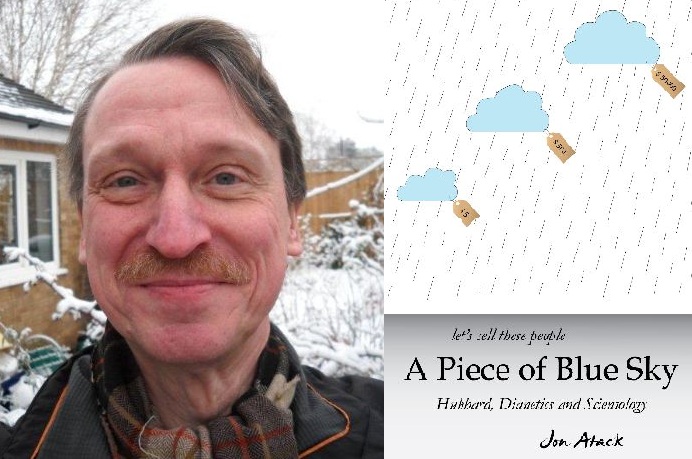
In 1990, author Jon Atack published what is still one of the very best books on L. Ron Hubbard and Scientology, A Piece of Blue Sky. Atack now has a new edition of the book out, and it reminded us what an encyclopedic resource he is. So we had an idea. In the world of Scientology watching, we noticed that there seem to be some legends, myths, and contested facts that tend to get hashed and rehashed in books, articles, and especially on the Internet. With Atack’s help, we’re going to tackle these issues one by one, drawing on Jon’s deep knowledge and sharp sense of humor.
This week, we have a great treat: Harlan Ellison is IN THE HOUSE. Yes, the legendary writer helped us out with our mythbusting this week, and that has thrown our entire program into disarray.
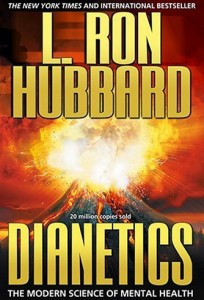
We’ll try to calm down and start at the beginning. What we wanted to discuss with Jon Atack this week was one of the most enduring parts of L. Ron Hubbard lore: Before he published Dianetics in 1950, did Hubbard really tell other people that he intended to make millions by starting a religion?
Welcome to our ongoing project, where we blog a 1950 first edition of Scientology’s bible, Dianetics, with the help of ex-Scientologist, Bay Area lawyer, blogger, and author Vance Woodward. Go here for the first post in the series.
In the last chapter, Hubbard made his big reveal, explaining that he had done what mankind had been unable to do for thousands of years — discover the nature of the reactive mind, which records our most awful moments during unconsciousness, and which plays back those moments at inopportune times. It’s the reactive mind that holds us back from being supermen.
As we pointed out, Hubbard had been setting readers up for this revelation for many pages, and then had announced his discovery with as much operatic force as he could muster.
That was all well and good, but he must have realized that he’s now made himself vulnerable. For any carnival barker, the build-up is 90 percent of the game, and once you reveal what it is you’ve been selling, you then have to worry about a backlash when your Feejee Mermaid, for example, turns out to be held together with papier-mâché.
Hubbard knows this, so in this next chapter, he does some fancy backpedaling.
Our thanks to Phil Plait, who alerted us to this on Twitter. Several amazing videos are coming in from the Ural Mountains region of Russia, where a meteor provided an incredible show about an hour ago (midnight Eastern time), near the city of Chelyabinsk.
Plait (of Bad Astronomer fame) guesses that this object is unrelated to 2012DA14, a 50-meter asteroid that is passing very close to the Earth in several more hours.
So far, the only reporting on this we’ve seen is a Reuters report mistakenly labeling this a “meteor shower.” This is clearly not a shower but a single object, a meteor, which looks like it broke up, producing parallel trails as it burned up in a spectacular daytime fireball.